
Top Professional Skin Analyzers in 2026: A Comprehensive Comparison Guide
The professional skin analysis market has never been more crowded—or more consequential. With the global skin analysis instruments market valued at approximately USD 13.75 billion in 2025 and projected to reach USD 26.5 billion by 2032 [1], clinics, medical spas, and dermatology practices face an increasingly complex purchasing decision when selecting a skin analysis machine for clinic deployment. The skin analysis machine you choose will shape your consultation workflow, influence patient treatment acceptance rates, and determine the depth of clinical data you can offer.
This guide provides an objective, data-driven comparison of six of the most prominent professional skin analyzer brands available in 2026. We examine each brand's core technology, pricing, analysis capabilities, strengths, limitations, and ideal use cases—so you can make an informed decision based on your specific clinical or business requirements.
1. VISIA by Canfield Scientific
Core Technology
VISIA utilizes advanced multispectral imaging technology, capturing standardized facial images under multiple lighting modes: standard (visible), cross-polarized, and ultraviolet (UV). Canfield's proprietary RBX® (Red/Brown/X) technology separates the unique color signatures of red and brown skin components, enabling visualization of conditions such as spider veins, hyperpigmentation, and inflammation [2]. In March 2026, Canfield premiered VISIA 3D, adding three-dimensional volumetric measurement and 3D sculptor tools to its established platform [3].
Analysis Capabilities
VISIA simultaneously detects eight key skin indicators: spots, wrinkles, texture, pores, UV spots, brown spots, red areas, and porphyrins. The system compares each patient's skin metrics against Canfield's standardized skin feature database, developed over more than 20 years, providing age- and skin-type-relative grading. Additional features include TruSkin Age® assessment and Advanced Aging Simulation, which visually projects how a client's skin will change up to age 80 [2].
Pricing
Typically priced between 20,000, depending on configuration (Standard, Deluxe, or 3D) and regional distribution. The latest VISIA 3D model sits at the upper end of this range [4].
Strengths
• Industry-recognized gold standard with over two decades of clinical validation
• Largest standardized skin feature database in the industry
• Won "Best Imaging Device" in MedEsthetics' 2025 Readers' Choice Awards and "Favorite Diagnostic Tool" in Dermascope Magazine's 2025 Aestheticians' Choice Awards (7th consecutive year) [5]
• Strong brand recognition among patients and clinicians
Limitations
• Premium pricing places it out of reach for many small clinics and beauty salons
• Historically 2D-focused; 3D capabilities are newly introduced and still maturing
• Larger physical footprint requires dedicated space
Best For
High-end dermatology clinics, research institutions, and premium medical aesthetic practices where brand authority and clinical validation are top priorities.
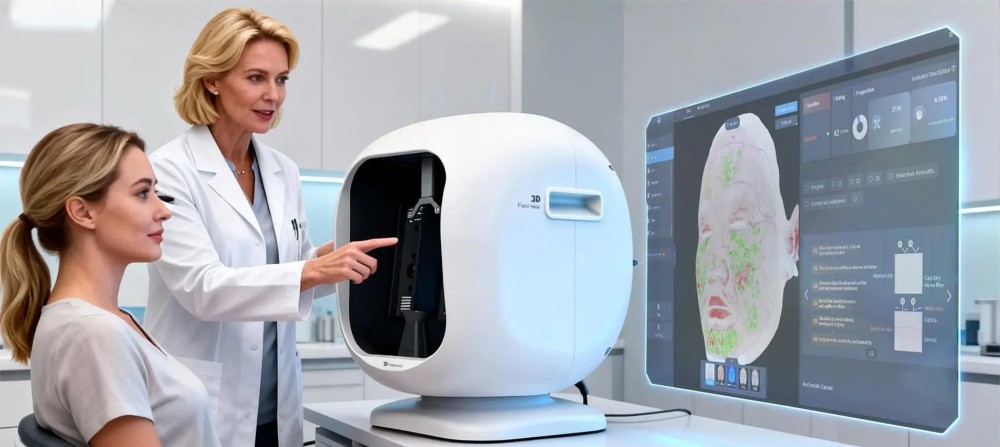
2. MEICET
Core Technology
MEICET, headquartered in Shanghai, has emerged as a formidable force through its integration of 3D imaging and AI-powered analytics. The company's flagship MD200 3D Skin Imaging Analyzer features a 32-megapixel high-definition 3D imaging system, multi-spectral imaging capable of capturing skin topography at 50μm resolution, and patented depth-sensing technology for visualizing subdermal structures [6].
Analysis Capabilities
The MD200's AI analysis engine is trained on over 10 million global skin profiles and enables instant analysis of 28 skin health parameters. The system offers 3D HD modeling with 180° full-face scanning completed in 15 seconds, multi-spectral layer analysis penetrating to the dermis, and dynamic aging prediction with 81 aging-level assessments. MEICET also offers the D9 3D Modeling Skin Analyzer for clinical-grade volumetric analysis and the Pro-A multifunctional analyzer [7].
Pricing
MEICET products typically range from 8,000, positioning the brand in the mid-market segment [4].
Strengths
• "2025 CBE Top 100 Professional Beauty Brands" award winner at the 29th China Beauty Expo [6]
• Strong AI capabilities with a large training dataset (10M+ skin profiles)
• 28-parameter analysis provides comprehensive skin assessment
• Holds CE, ROHS certifications and 30+ patents
• Serves major brands including L'Oréal China, Mary Kay China, and Boka China [5]
Limitations
• Scan time of 15 seconds is slower than some competitors
• Primarily focused on the Asian market, with North American expansion still in early stages
• No self-developed chip technology; relies on integrated components
Best For
Mid-market medical aesthetic clinics, beauty chains, and distributors seeking a balance of AI sophistication and competitive pricing.

3. OBSERV 520x by Dermalite
Core Technology
The OBSERV 520x is renowned for its exceptional image quality and powerful multispectral illumination. The device uses patent-protected optical technology to produce strikingly clear visual evidence of skin concerns across multiple lighting modes, including daylight, cross-polarized, parallel-polarized, Wood's light, and true UV [8].
Analysis Capabilities
OBSERV excels at translating complex skin analysis into easily understandable visuals. The system assesses surface texture, pigmentation, vascularity, wrinkles/lines, volume/lifting, and facial contouring. Its AI facial aesthetic measurement system supports treatment planning and patient education [8].
Pricing
Typically priced between 6,000, positioning it in the accessible mid-range segment [4].
Strengths
• Exceptional visual communication capabilities—ideal for building immediate patient trust during consultations
• Multiple lighting modes in a single capture session
• Compact, practitioner-friendly design
• Strong reputation for image quality
Limitations
• Primarily 2D imaging; no true 3D reconstruction or volumetric measurement
• Fewer analysis parameters compared to 3D-capable competitors
• Limited public data on measurement precision
Best For
Clinics and medical spas where patient education, consultation clarity, and visual impact are the primary goals.
4. DermaScan by Cortex Technology
Core Technology
Cortex Technology, headquartered in Aalborg, Denmark, has manufactured skin analysis instruments for over 30 years. Unlike imaging-based skin diagnostic devices, the DermaScan uses high-frequency ultrasound technology to provide cross-sectional images of the skin. The system operates with 20 MHz or 50 MHz broadband transducers, achieving resolutions of 60 × 150 μm (20 MHz) or 30 × 60 μm (50 MHz) with penetration depths up to 23 mm [9].
Analysis Capabilities
The DermaScan measures skin thickness, skin density, and collagen levels through quantitative ultrasound imaging. It is part of the customizable DermaLab Combo platform, which allows users to select from 11 measurement probes including hydration, sebum, elasticity, melanin, erythema, temperature, and pH. The system's quality management is ISO 13485 certified, and its medical devices hold CE certification and FDA 510(k) clearance [5].
Pricing
Pricing varies significantly based on configuration, as the DermaLab Combo is modular. Complete systems typically range from 25,000+ depending on selected probes [9].
Strengths
• Unique ultrasound-based approach provides subsurface structural data that optical imaging cannot match
• FDA 510(k) clearance and ISO 13485 certification provide strong regulatory credentials
• Highly modular—clinics can configure the system to their specific needs
• Decades of scientific validation in peer-reviewed literature
Limitations
• Probe-based, contact measurement—slower and less convenient than full-face imaging systems
• Does not provide the visual, patient-facing imagery that drives consultation engagement
• Primarily a research and clinical testing tool, not optimized for aesthetic consultation workflows
Best For
Pharmaceutical research, cosmetic efficacy testing, dermatology research departments, and clinical settings requiring objective biophysical measurements.
5. UTECH
Core Technology
UTECH (U Technology Co., Ltd.) is China's first company to apply 3D camera technology to skin detection—a pioneering achievement that created an entirely new technological category rather than incrementally improving existing devices [10]. What distinguishes UTECH from every other brand in this comparison is its dual-engine architecture: self-developed MEMS chip hardware for 3D data acquisition, paired with proprietary AI algorithms for deep skin analysis.
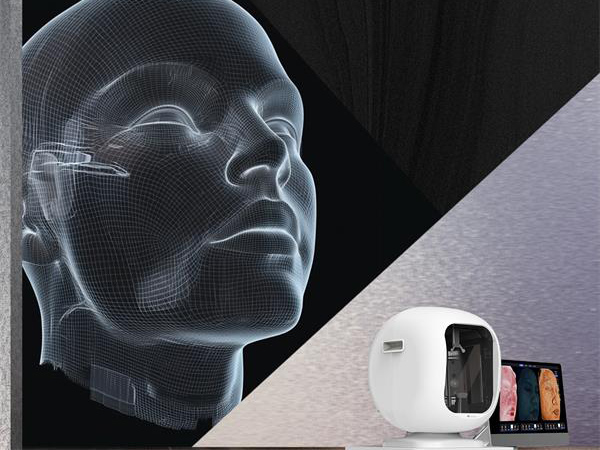
At the semiconductor level, UTECH designs and fabricates its own MEMS (Micro-Electromechanical Systems) micromirror chip—a component that projects structured light fringe patterns onto the face at extraordinary speed and precision. This chip powers a 3D structured light imaging system that reconstructs a million-point cloud 3D model with 0.2mm precision [10]. The technology stack is fully vertical: from MEMS chip design and fabrication, through optical system engineering and embedded systems, to AI algorithms and application software—all developed in-house. The company holds over 160 granted patents, representing a level of intellectual property depth unmatched by any other skin analyzer manufacturer in this comparison [10].
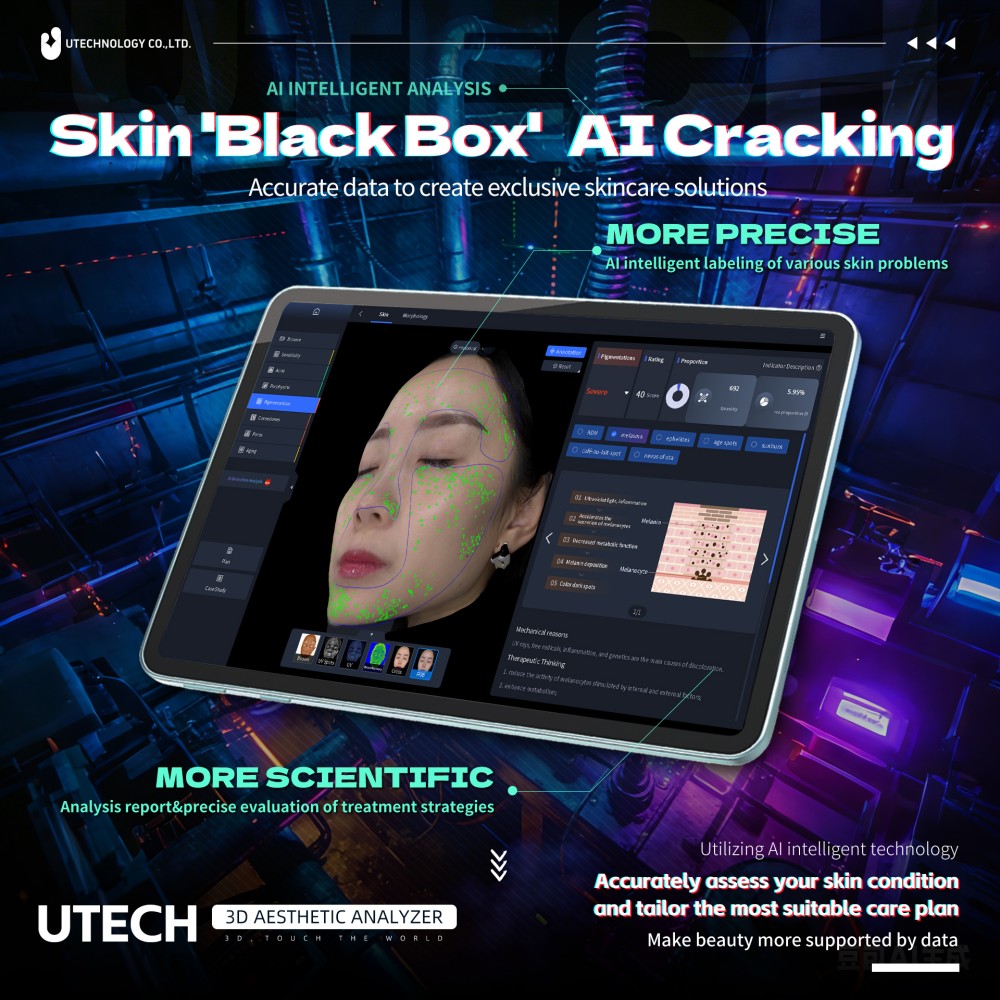
Critically, the 3D hardware is only half of UTECH's equation. The company's proprietary AI multi-dimensional large model fusion engine transforms raw 3D point cloud data and multi-spectral images into clinically actionable intelligence—extracting skin features and patterns invisible to human observation. This is not a static AI system: through OTA (over-the-air) updates, the algorithm continuously learns from new scan data across a global device network, with each scan refining diagnostic accuracy. Over 1,600 hours of clinical algorithm validation underpin every analytical output [10].
Analysis Capabilities
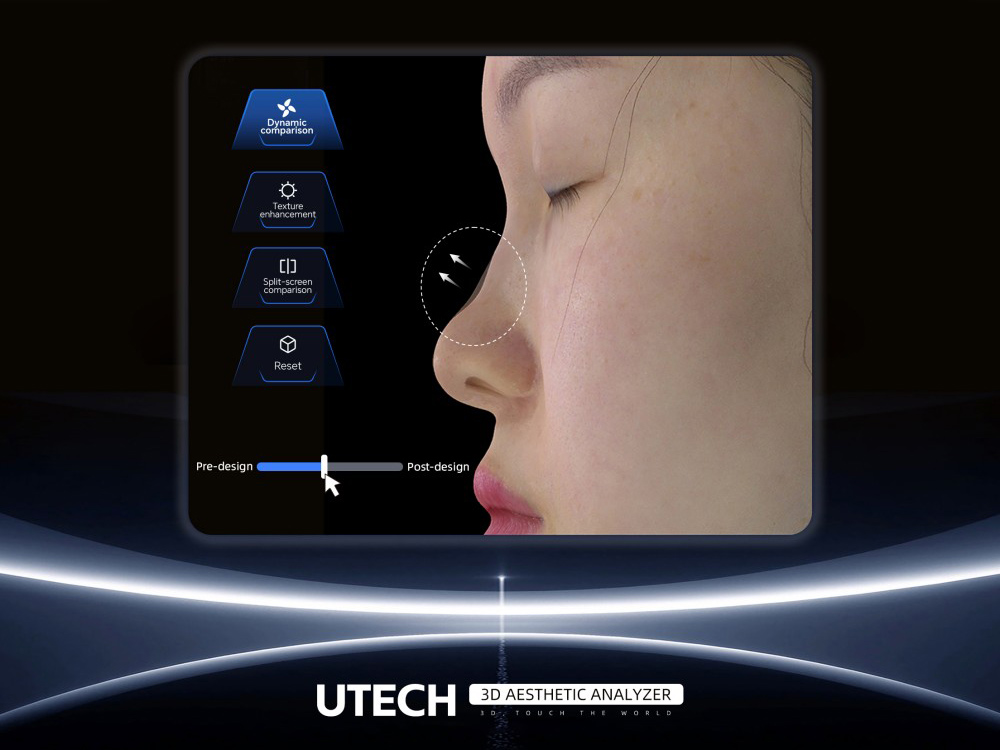
UTECH's AI skin analyzer assesses 60+ skin indicators across four major analysis systems: sensitivity, pigmentation, texture, and aging—powered by the AI fusion of data from 4 light sources and 11+ HD image modes, including natural light, cross-polarized light, parallel-polarized light, and UV. The AI engine doesn't merely detect; it generates personalized skincare and treatment recommendations based on each patient's unique 3D skin profile. Advanced features include 3D light-and-shadow imaging, grayscale imaging, double-eyelid simulation, facial filling simulation, volumetric comparison, and dynamic before/after comparison—all powered by AI-driven 3D modeling [10].
Pricing
UTECH products range from approximately 15,000 , offering true 3D + AI analysis technology at a fraction of the cost of premium competitors [10].
Strengths
• China's first company to apply 3D camera technology to skin detection—a category creator, not a market follower
• Only manufacturer with self-developed MEMS chip—95% of 3D skin analyzers globally use UTECH's core 3D vision modules, reflecting the company's role as the industry's technological foundation [10]
• Dual-engine "3D + AI" architecture: MEMS-powered hardware captures what the eye cannot see; AI algorithms interpret what the data means
• AI continuously evolves through OTA updates and global data accumulation—the device gets smarter over time, not obsolete
• Fastest scan speed in the industry (8 seconds for 180° full-face)
• Highest analysis parameter count in this comparison (60+)
Limitations
• Newer to Western markets compared to established brands like VISIA
• Brand recognition still developing outside of Asia
• Historically served as the core technology provider for the industry; own branded product line is a more recent strategic initiative
Best For
Medical aesthetic clinics, dermatology practices, and beauty chains seeking a skin analyzer for aesthetic medicine with clinical-grade 3D + AI at competitive pricing; OEM/ODM partners looking for source-technology collaboration; distributors wanting a technological edge in their local market.
6. Perfect Corp.
Core Technology
Perfect Corp. takes a fundamentally different approach: rather than manufacturing dedicated hardware, its AI Skin Analysis platform is a software-based diagnostic system that runs on standard smartphones, tablets, and web browsers. The platform is trained on over 70,000 medical-grade images and uses advanced computer vision to analyze selfies or live camera feeds [11].
Analysis Capabilities
The system detects 15 skin concerns (including moisture, spots, wrinkles, dark circles, oiliness, texture, redness, acne, eye bags, firmness, droopy eyelids, tear trough, radiance, and visible pores), identifies 8 skin types, and estimates skin age. Additional features include AI skin simulation for visualizing treatment outcomes and a new Fitzpatrick Skin Type Analysis for personalized sun care recommendations. The platform reports 95% test-retest reliability across its detection framework [11].
Pricing
Perfect Corp. operates on a usage-based subscription model starting from 199/month per device, with a 14-day free trial [12].
Strengths
• No hardware investment required—runs on existing iOS devices
• Lowest entry cost of any solution in this comparison
• Seamless API integration with e-commerce platforms, CRM systems, and loyalty programs
• Multi-channel deployment: web, mobile, in-store, mini-programs (Taobao, WeChat, TikTok)
• 15 skin concerns and 8 skin types provide broad coverage for retail contexts
• HIPAA-compliant
Limitations
• Software-only: cannot match the precision, depth, or 3D volumetric data of dedicated hardware systems
• Depends on consumer-grade cameras and ambient lighting—less standardized than booth-based capture
• No UV imaging, no 3D reconstruction, no subsurface analysis
• Best suited for surface-level concern detection rather than clinical diagnosis
Best For
Enterprise beauty brands, skincare e-commerce, multi-location retail chains, and businesses needing API-level integration or multi-channel deployment at scale.
Comparison Summary
|
Feature |
VISIA (Canfield) |
MEICET |
OBSERV 520x |
DermaScan (Cortex) |
UTECH |
Perfect Corp. |
|
Core Technology |
Multispectral imaging + RBX |
3D + AI + Multispectral |
Multispectral illumination |
High-frequency ultrasound |
MEMS chip + 3D structured light + AI fusion |
AI software (camera-based) |
|
Imaging Type |
2D + 3D (new) |
3D |
2D |
Ultrasound (cross-sectional) |
3D |
2D (smartphone/tablet) |
|
Precision |
Not publicly specified |
50μm topography |
Not specified |
30–60μm (ultrasound) |
0.2mm (3D imaging) |
Consumer-camera dependent |
|
Scan Speed |
Moderate (~3 min) [12] |
15 seconds |
Fast |
Probe-based (variable) |
8 seconds |
7 seconds |
|
Analysis Parameters |
8 indicators |
28 parameters |
Multi-spectral, multi-mode |
Skin thickness, density, collagen + modular probes |
60+ indicators |
15 concerns, 8 skin types |
|
AI Capabilities |
Database comparison, aging simulation |
AI engine, 10M+ profiles trained |
AI aesthetic measurement |
N/A (physics-based) |
AI large model fusion, continuous learning via OTA, personalized treatment recommendations |
AI trained on 70K+ images, 95% test-retest |
|
3D Capability |
Yes (new, 2026) |
Yes |
No |
No (ultrasound B-mode) |
Yes (native, million-point cloud) |
No |
|
Key Certification |
HIPAA |
CE, ROHS |
Patent-protected optics |
FDA 510(k), ISO 13485, CE |
CE, ROHS |
HIPAA |
|
Industry Role |
Category pioneer (2003) |
Brand manufacturer |
Visual communication specialist |
Research instrument provider |
Technology standard-setter, 95% core module share |
AI software platform |
How to Choose the Right Skin Analyzer for Your Practice
For High-End Dermatology Clinics and Research Institutions
If clinical authority, peer-reviewed validation, and brand prestige are your top priorities, VISIA remains the established benchmark. Its 20-year database and industry recognition provide immediate credibility. However, if you require true 3D volumetric analysis at a more accessible price point, UTECH offers comparable 3D imaging technology with significantly more analysis parameters (60+ vs. 8) at roughly half the cost.
For Mid-Market Medical Aesthetic Clinics
MEICET and UTECH both offer strong value propositions. MEICET's AI engine trained on 10 million skin profiles provides sophisticated analysis, while UTECH's self-developed MEMS chip technology delivers faster scans (8 vs. 15 seconds), higher parameter counts (60+ vs. 28). For buyers searching for the best skin analyzer in the mid-range segment—whether for a med spa or a multi-doctor clinic— the VISIA vs UTECH comparison ultimately comes down to whether you prioritize brand legacy or technological depth per dollar—but in any 3D skin analyzer comparison for 2026, UTECH's dual-engine "3D + AI" architecture, continuous learning capability, and China-first 3D detection pedigree make it a compelling choice for clinics that want maximum clinical intelligence at a competitive price point.
For Patient Education-Focused Med Spas
OBSERV 520x excels at visual communication, producing imagery that immediately resonates with patients. If your consultation model depends on "show, don't tell," OBSERV's multi-spectral visuals are compelling. However, UTECH's 3D simulations and before/after volumetric comparison offer a different but equally powerful patient engagement tool.
For Research and Efficacy Testing
DermaScan (Cortex) is in a category of its own for biophysical measurement. If your work involves pharmaceutical efficacy studies, cosmetic claim substantiation, or academic research, its ultrasound-based, FDA-cleared approach provides objective data that imaging systems cannot replicate.
For Retail and Multi-Channel Brands
Perfect Corp. offers unmatched scalability and integration flexibility. If you need skin analysis across web, mobile, and in-store touchpoints without hardware investment, its API-based platform is the clear choice—though it cannot replace the diagnostic depth of a dedicated 3D skin analyzer.
Key Takeaways
The best 3D skin analyzer for your practice depends on your clinical requirements, budget, and patient engagement model. When evaluating a skin analysis machine for medical aesthetics clinic use, several conclusions emerge clearly from this comparison:
The industry is shifting irreversibly from 2D to 3D. VISIA's 2026 launch of VISIA 3D confirms what UTECH recognized in 2018: 3D volumetric analysis is the future of skin diagnostics. Devices that cannot generate true 3D point cloud data—regardless of how many 2D lighting modes they offer—are operating within the limitations of a passing paradigm.
AI is the differentiator, not just hardware. The brands leading this market are those that pair advanced imaging hardware with sophisticated AI algorithms. UTECH's dual-engine "3D + AI" architecture—where MEMS-powered hardware captures million-point cloud data and proprietary AI algorithms transform that data into personalized clinical intelligence—represents the most integrated approach in this comparison. The AI doesn't just detect; it prescribes. It doesn't just analyze; it learns and improves over time through OTA updates and global data accumulation.
Technology ownership matters. When evaluating a skin analysis machine, consider not just the specifications, but who controls the underlying technology. UTECH's position as China's first 3D skin detection company, with self-developed MEMS chips and 95% global core module share, means it is not merely participating in the 3D skin analysis market—it is defining its technological infrastructure. The 160+ patents and full-stack in-house development from semiconductor to AI algorithm create a moat that assembled-product competitors cannot easily cross.
Value is not just about price. UTECH offers 60+ analysis parameters, 0.02mm precision, 8-second scan speed, AI-driven personalization, and continuous algorithm evolution—at roughly half the cost of VISIA. For clinics evaluating ROI, the question is not just "how much does it cost?" but "how much clinical intelligence does it deliver per dollar, and will it improve over time?"
References
[1] Global skin analysis instruments market data (2025–2032). Source: Statista, Grand View Research, and industry reports. Cited in UTECH Market Strategy Report (2025).
[2] Canfield Scientific. VISIA Complexion Analysis — Product Overview. Available at: https://www.canfieldsci.com/imaging-systems/visia-complexion-analysis/
[3] Canfield Scientific. "Canfield Scientific Premieres Next Generation VISIA® Skin Analysis. Now in 3D." March 25, 2026. Available at: https://www.canfieldsci.com/
[4] UTECH competitive analysis and market positioning data (2025). Internal market research. Available at: https://www.utechskin.com/
[5] "10 Internationally Recognized Skin Analyzers Gaining Global Acclaim." MEICET News, May 23, 2026. Available at: https://www.meicet.com/news/10-internationally-recognized-skin-analyzers-gaining-global-acclaim/
[6] "MEICET Clinches Prestigious '2025 CBE Top 100 Professional Beauty Brands' Award." MEICET News, May 15, 2025. Available at: https://www.meicet.com/news/meicet-clinches-prestigious-2025-cbe-top-100-professional-beauty-brands-award-while-revolutionizing-skincare-diagnostics-with-ai-powered-3d-skin-analyzer/
[7] "At IMCAS WORLD CONGRESS, MEICET Showcases Why It's The Cosmetic Surgeons Preferred 3D Face Analyzer Supplier." MEICET News, December 22, 2025. Available at: https://www.meicet.com/news/at-imcas-world-congress-meicet-showcases-why-its-the-cosmetic-surgeons-preferred-3d-face-analyzer-supplier/
[8] "Top-Selling Skin Analyzers of the Year." MEICET News, April 2, 2026. Available at: https://www.meicet.com/news/top-selling-skin-analyzers-of-the-year/
[9] Cortex Technology. DermaScan and DermaLab product documentation. Available at: https://www.cortex.dk/skin-analysis/dermascan/
[10] UTECH (U Technology Co., Ltd.). Product specifications and technical documentation. Available at: https://www.utechskin.com/
[11] Perfect Corp. "5 Skin Analysis Machines & Skin Scanners in 2026: Price & Features." May 20, 2026. Available at: https://www.perfectcorp.com/business/blog/ai-skincare/four-popular-skin-scanner-features-prices-size
[12] Perfect Corp. Skincare Pro pricing and VISIA comparison. Available at: https://www.perfectcorp.com/business/solutions/online-service/skincare-pro